What Is a Lookback Window and How Does It Work?
A lookback window is how far back a community weighs your rental history — often 2-3 years. How it makes older broken leases placeable.
A lookback window is the key mechanism that makes an older broken lease placeable. If you have a break from 2-5 years ago, understanding the window explains why your options are wider than a recent-break renter’s — and why they’re not unlimited.
The window explained
Every apartment community configures rules that determine what triggers a denial on a rental-history report. The lookback window is the time boundary on those rules. A community with a 2-year lookback window scores rental-history events within the last 24 months against the applicant. Events older than 24 months on the same report are typically ignored for denial purposes.
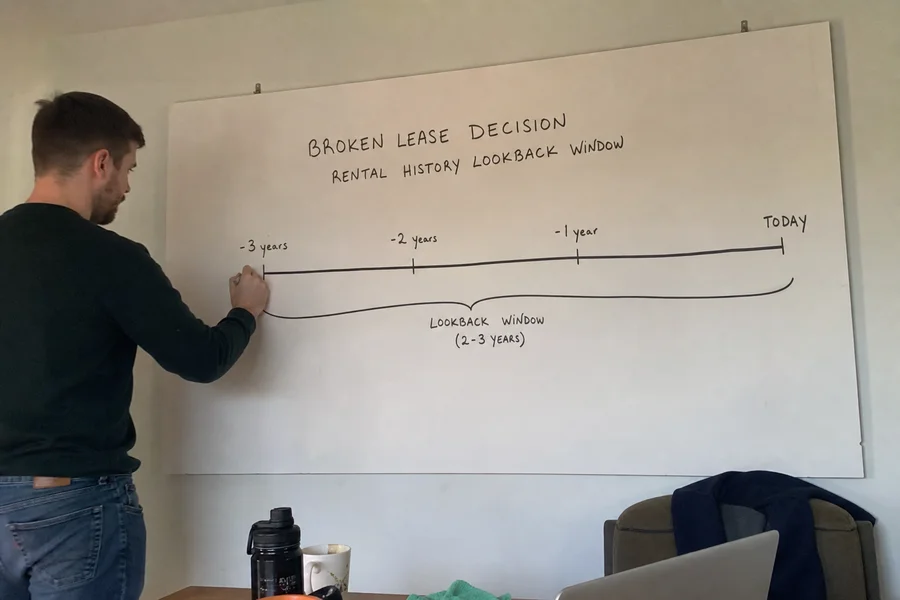
So a broken lease from month 30 hits a 3-year window (“within 36 months”) but not a 2-year window (“within 24 months”). Same renter, same record — different outcome depending on which community’s window is doing the scoring.
Why windows vary
The window length is a risk policy setting the property management company (PMC) picks. Longer windows are more conservative — a 5-year window means old events keep weighing. Shorter windows are more permissive — a 24-month window means events age out fast.
PMCs choose based on their target demographic, competitive pressure, and portfolio-level risk appetite. In a high-supply market (like Austin post-2022), some PMCs shorten windows to widen their acceptable-applicant pool. In a tight market, they may lengthen them.
Individual property managers can also request custom windows for their specific community even within a PMC portfolio, so windows sometimes vary within the same company. That’s why “PMC X uses 3-year windows” is a generalization with exceptions.
Report visibility vs denial trigger
An important distinction: the window controls whether the event triggers denial, not whether the event appears on the report. Your broken lease can still appear on your NCAC or LeasingDesk report years past the window. Rental-history vendors retain records for their full retention period (often 7 years) regardless of how communities score them.
Property managers still see the record in the report. They just don’t score it against you. In practice this often looks like: the leasing agent notes the break, reads it as “outside our window,” and moves on.
Windows across screening vendors
The vendor (NCAC, LeasingDesk, SafeRent) doesn’t set the window — the community does, and it applies to whatever data comes in from any vendor. So the window is a property-side setting, not a vendor-side one.
That said, vendors do have their own data retention policies. NCAC retention is typically 7+ years. LeasingDesk and SafeRent retention varies but is generally in the same range. So even the longest community lookback window (5 years) fits inside typical vendor retention — the data is there to be scored, or ignored, depending on the community’s rule.
Practical implications
If your broken lease is 24-35 months old, you’re on the boundary. Communities with 2-year windows treat you as clear; communities with 3-year windows still weigh the record. Our shortlist focuses on the first group.
If it’s 36+ months old, you’re clear at most 3-year windows and comfortably clear at 2-year ones. The remaining constraint is usually credit-report side (if the debt went to collections) rather than rental-history side.
Related reading
Frequently asked
How long is a typical lookback window?
Most Texas communities use 2 or 3 years, though some use 4 or 5. The specific window is a community-configurable policy setting.
Does every community use one?
Most do, but the length differs — which is exactly why options open up as your broken lease ages. Some communities use no explicit window and score every event on the report.
Does the window reset if I pay?
Paying doesn't reset the rental-history lookback window. The window is set on age of the event, not payment status. Paying can help other checks (credit report scoring) but not the window itself.
Turn this into a placement.
Our agents will match you with Texas communities that fit your specific scenario.