Renting After a Broken Lease With No Rental History Since
No rental history since your break? Placement leans on income and employment. What PMCs weigh instead and why this pool is smaller but real.

If you have no rental history since your broken lease, your options are narrower than they would be with completed leases behind you — but they’re not empty. The path to placement leans on the two variables you can influence: income and documentation. This guide walks through what property managers weigh instead of rental history and where the openings are.
The starting position, honestly
Let’s name the situation plainly. You have a broken lease on your rental-history record. You have no completed leases since — usually because you’ve been staying with family, living with a partner or roommate informally, or the previous tenancy was your only formal one. Your rental screening report shows the break and shows nothing after it.
That’s the starting position. It’s harder than a scenario with a completed lease since (which would offset the break) and it’s harder than a scenario where the break is aged past a lookback window. But it’s placeable — with the right emphasis on the levers that do exist.
Income and employment stability carry the application
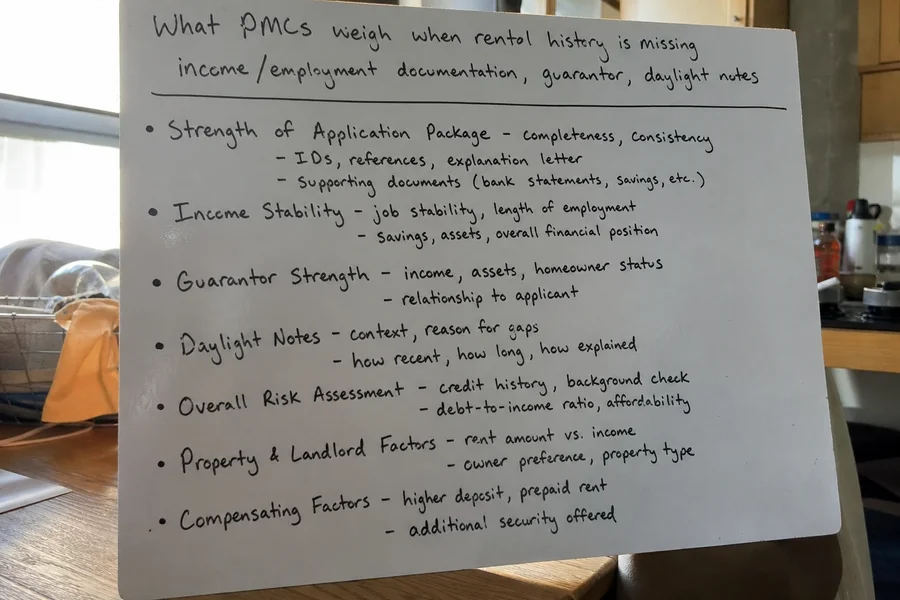
When there’s no rental history to offset the broken lease, income becomes the primary lever. Communities that keep a case-by-case review path for no-history renters typically look for:
- Higher income multiplier. 3.5x-4x rent instead of the baseline 3x. Documented and verifiable.
- 12+ months of employment. Consistent employment at the same employer signals stability. Job history under 6 months is a red flag.
- Reasonable cash reserves. 3-6x monthly rent in savings signals cushion against short-term hiccups.
- Complete documentation. Pay stubs, employment verification letter, and recent bank statements ready at application.
Not every community weighs income the same way. Some target 3.5x specifically, some go higher. Some care about employment length more than dollar amount, some the reverse.
Documenting informal payment history
If you’ve been paying rent informally to family, a roommate, or a private landlord, that history is real but invisible to screening. Making it visible is one of the highest-leverage things you can do.
Build a paper trail:
- App payment records (Venmo, Zelle, Cash App). Label rent payments if you can. Export or screenshot the transaction history.
- Signed statement from the person you paid. Their name, your name, address, monthly amount, payment method, and dates covered. Include their contact info.
- Bank statements. Cross-reference the outbound payments to their labeled or matching entries.
We walk through this in more detail in how to document private landlord or roommate rent payments.
Guarantors as the last-mile fix
If income alone doesn’t quite clear the bar, a third-party guarantor can close the gap. Providers like Insurent, TheGuarantors, and Jetty co-sign your lease for a fee (typically 5-12% of annual rent). Their underwriting requires higher income on the guarantor’s side (typically 27x-50x monthly rent), so they work as a bridge more than an escape hatch.
Two rules for guarantors in a no-history scenario:
- Confirm the community accepts a guarantor for a broken-lease application specifically. Some don’t — they treat the break as behavioral rather than financial.
- Add the guarantor fee to your total move-in cost math. On $1,500 rent an 8% guarantor fee is $1,440, added to first month + deposit + any risk fee.
Detailed walk-through: guarantor guides.
Why the pool is smaller but real
The pool of communities that will approve a broken-lease-no-history-since application is smaller than for other broken-lease scenarios. It’s typically communities that either:
- Weight income heavily in their scoring rules
- Have policies that specifically accommodate first-time-since-break applications
- Accept guarantors for broken-lease scenarios
These communities exist across every Texas metro but they’re a subset. Our free search starts from a current shortlist.
Related reading
Frequently asked
Can I rent with no rental history since my broken lease?
Yes. Income and employment stability can carry the application. Communities that weigh income heavily in conditional approvals are the target list for no-history renters.
What do communities look at instead of rental history?
Income multipliers (often 3.5x-4x rent), employment length, savings, documented informal payments, and — for renters just below the income threshold — a third-party guarantor.
Is a guarantor a good option here?
Yes, it's a common bridge when rental history is missing. But some communities won't accept a guarantor for a broken lease specifically — we check acceptance before you commit.
Turn this into a placement.
Our agents will match you with Texas communities that fit your specific scenario.