How to Write a Letter of Explanation for a Recent Broken Lease
A strong letter of explanation can turn a denial into a conditional approval. What to include, the right tone, and which documents to attach.

A letter of explanation is one of the highest-leverage documents in a broken-lease application. Done well, it turns a case-by-case review from “leaning no” into “conditionally yes.” Done poorly — too long, too emotional, too vague — it does nothing or hurts.
What a letter of explanation is (and isn’t)
A letter of explanation is a short, factual document that accompanies your rental application. It states the circumstances of your broken lease, what changed since, and what your current situation looks like. It’s addressed to the property manager or leasing agent and read alongside your income documentation and screening report.
It’s not a plea for sympathy, a legal defense, or a place to argue the former community was wrong. It’s a factual summary that helps a human reviewer understand a situation the screening algorithm couldn’t nuance.
What to include
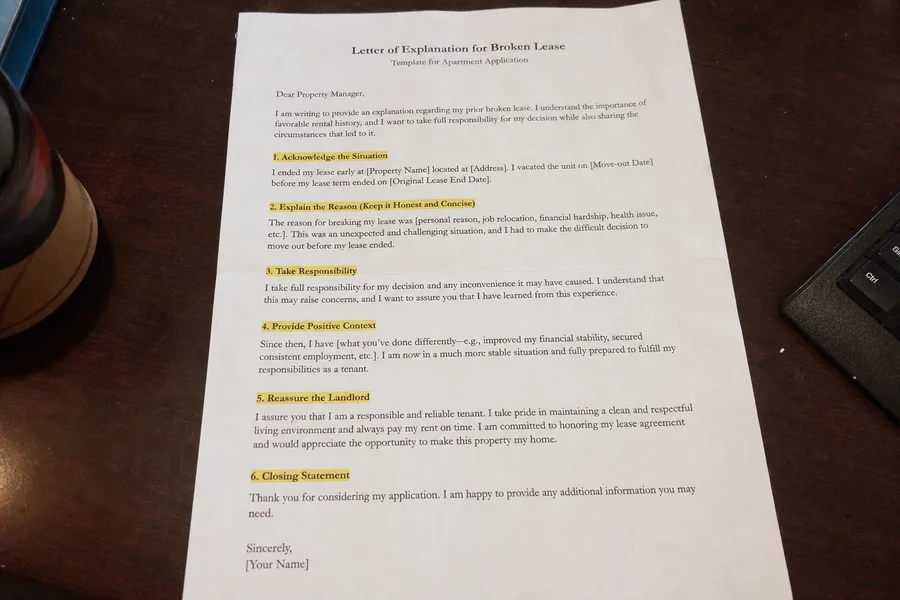
Structure the letter in four short paragraphs:
1. Acknowledgment. State that you had a broken lease. Name the community, the year, and the balance amount if known. One or two sentences.
2. Circumstance. Briefly explain what happened. Job loss, family emergency, unsafe living situation, roommate default — whatever the actual reason. Be honest and specific but not detailed to the point of over-sharing. One paragraph.
3. Resolution status. Where does the balance stand? Paid, settled, in collections, in payment plan? If paid or settled, mention the letter you have. One or two sentences.
4. Current situation. Employment length, current income, why this application is stable. What’s changed since the broken lease that makes this application different. One paragraph.
Close with a line thanking the property manager for their consideration and offering to answer questions.
That’s it. One page or less. Times New Roman or a plain sans-serif at 11-12 pt. Signed and dated.
The tone that works
Two things matter for tone:
Factual, not emotional. “I had a broken lease in 2024 due to a job loss” reads well. “I was going through the worst time of my life and had no choice” reads poorly. Property managers see a lot of applications — a factual tone communicates you can be worked with; an emotional tone communicates instability.
Brief, not comprehensive. The reviewer isn’t looking for the whole story. They’re looking for enough context to justify moving to conditional approval. Extra detail is noise that dilutes the important information.
What to attach
The letter is stronger when it’s paired with:
- Proof of income. Two most recent pay stubs, or an employment verification letter from HR stating your role, employment date, and salary.
- Balance documentation. If paid or settled: the paid-in-full letter, settlement agreement, or zero-balance confirmation.
- Stability evidence. If applicable: bank statements showing consistent balance and payment history, or landlord verification letters from any tenancy since.
Don’t attach: the original lease, correspondence with the former community, screenshots of arguments, or medical/legal records unless directly relevant.
When it’s read carefully
At a community running manual review, the letter is read carefully. At a community running fully automated screening, it may not be read at all — the screen decides first, and only if you follow up manually is the letter escalated.
Our agents know which communities read letters at intake vs on request. That affects how you send it — as an attachment with the application vs as a follow-up email to the leasing agent.
Related reading
Frequently asked
How long should the letter be?
Short — a few clear paragraphs, ideally one page or less. PMCs skim these; a factual, concise letter is read fully. A long or emotional one gets scanned.
What should I attach?
Proof of income (recent pay stubs), any settlement or paid-in-full letters, and evidence of stability since the break (bank statements, employment verification, references).
Does every community ask for one?
No. Some communities never ask, others require one for any broken-lease application, and others weigh it heavily when it's included proactively. Having one ready helps regardless.
Turn this into a placement.
Our agents will match you with Texas communities that fit your specific scenario.